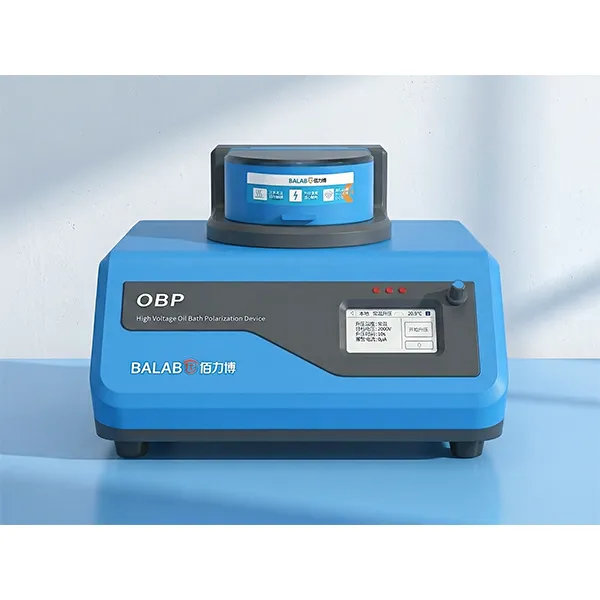
Overview
As a professional manufacturer, we offer the MatMeas OBP Series High Voltage Polarization Instrument, specifically engineered for the efficient poling of piezoelectric ceramics. This precision supply is suitable for both bulk and thin-film samples. It features a high-precision, low-ripple DC output to effectively align domains in piezoelectric materials. By providing real-time current monitoring and multiple safety protections, it enables researchers to confidently optimize poling processes (temperature, voltage, time) to achieve maximum piezoelectric performance. Its compact, integrated design makes it an ideal tool for laboratory R&D and small-scale production in advanced technical fields.
Specifications
| Parameter | Value |
| Polarization Method | Oil Bath |
| Polarization Channels | 1 |
| Polarization Voltage | 10KV / 30KV (Selectable) |
| Protection Current | 1mA max. per channel |
| Polarization Temperature | RT ~ 180℃ |
| Minimum Detectable Current | ≥100nA |
| Heating Rate Slope | 3℃/min, 6℃/min, 9℃/min |
| Sample Materials | Bulk / Thin Film |
| Safety Feature | Optical sensor interlock for power cut-off |
| Weight | 8kg |
| Warranty | 1 Year |
| Equipment Dimensions (L×W×H) | 345 × 335 × 243 mm (L×W×H) |
| Power Supply | 220V / 50Hz~60Hz, 600W |
| Voltage Accuracy | ±5% |
Applications
- Aerospace Defense
FOR high-performance actuators AND sensors in gyroscopes AND adaptive optics. - Precision Machinery&Automation
Poling of piezoelectric stacks AND benders FOR micro-positioning AND ultrasonic devices. - Semiconductor Microelectronics
R&D on piezoelectric thin films FOR MEMS AND energy harvesting. - Biomedical Engineering
Development of piezoelectric materials FOR ultrasound transducers AND energy harvesting devices.
More Details
- Why choose the OBP Series?
Process Optimization:The ability to monitor real-time polarization current is crucial. Observing how the current changes over time under applied voltage and temperature helps researchers identify the ideal poling conditions (saturation point) for new or existing materials, avoiding under-poling or dielectric breakdown. - Versatility: It supports both bulk ceramics and thin films, accommodating a wide range of R&D and production needs.
- Reliability and Safety: Integrated safety features like overcurrent protection, isolated shielding, and safety interlocks protect both the valuable samples and the operator, ensuring a safe and repeatable poling process.